MANI Indústrias Plásticas is in the thermoforming business for more than 40 years and along this time has acquired a large experience in this field.
- We are specialized in the production of PP, PET and PS packaging for the food industry, especially Home Meal Replacement and Bakery products
- We produce on modern high-production extrusion and thermoforming equipment
- We stock all items and try to deliver next day
Select from the following product ranges:
- Home Meal Replacement Range
- Bakery Range
Square Hinged and Rectangular Hinged PET containers for bakery products.
- Plates
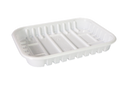
- Trays
- Raw Materials
We manufacture our packaging using different raw materials:
-
Polypropylene or polypropene (PP) is a thermoplastic polymer, made by the chemical industry and used in a wide variety of applications, including food packaging, ropes, textiles, plastic parts and reusable containers of various types, thermal pants and shirts made for the military, laboratory equipment, loudspeakers, automotive components, and polymer banknotes. An addition polymer made from the monomer propylene, it is rugged and unusually resistant to many chemical solvents, bases and acids.
Antifog
The term "fog" is used to describe the condensation of water vapour on the surface of a transparent plastic film in the form of small discrete droplets. Physical conditions leading to this phenomenon are:
- A decrease in temperature on the inside of the film below the dew point of the enclosed air/water vapour mixture.
- Cooling of the air near the film to a temperature at which it can no longer retain all water vapour; excess water condenses upon the film.
Internal antifog agents are directly incorporated into plastics to achieve the spreading of condensed water droplets into a continuous and uniform layer of water on the fabricated film.
Internal antifog additives are surface active agents, which have a balanced incompatibility with the polymer matrix. They are added during the extrusion process in pure form, as concentrate or masterbatch. When the film is made they are uniformly dispersed throughout its thickness but they subsequently migrate to the film surface, where they increase the critical wetting tension.
This combined with a partial solubility of the antifog agent in water, which leads to a decrease in surface tension of the water, will significantly diminish the difference between the surface tension of water and the polymer.
-

Amorphous Polyethylene Terephthalate APET is a thermoplastic polymer resin of the polyester family that produced by the chemical industry and is used in synthetic fibers; beverage, food and other liquid containers; thermoforming applications; and engineering resins often in combination with glass fiber. It is one of the most important raw materials used in man-made fibers.
Depending on its processing and thermal history, it may exist both as an amorphous (transparent) and as a semi-crystalline (opaque and white) material. Its monomer can be synthesized by the esterification reaction between terephthalic acid and ethylene glycol with water as a byproduct or the transesterification reaction between ethylene glycol and dimethyl terephthalate with methanol as a byproduct. Polymerization is through a polycondensation reaction of the monomers (done immediately after esterification/transesterification) with ethylene glycol as the byproduct (the ethylene glycol is recycled in production).
The majority of the world's PET production is for synthetic fibers (in excess of 60%) with bottle production accounting for around 30% of global demand. In discussing textile applications, PET is generally referred to as simply "polyester" while "PET" is used most often to refer to packaging applications.
rPET (recycled PET)
rPET contains a minimum of 50% of PET derived from post consumer recyclate (PCR) whilst meeting the approved requirements for direct food contact. rPET is a versatile food packaging material having a gas barrier for increased shelf life, superb clarity, strength and rigidity that makes it the material of choice for retailers. rPET is not only made using recycled post consumer waste, it can itself be recycled through approved material recovery facilities.
Recycled PET packaging that can itself be recycled is our contribution to help reduce landfill waste whilst maintaining the safety and protection of food.


-

Polystyrene is a polymer made from the monomer styrene, a liquid hydrocarbon that is commercially manufactured from petroleum by the chemical industry. At room temperature, polystyrene is normally a solid thermoplastic, but can be melted at higher temperature for molding or extrusion, then resolidified. Styrene is an aromatic monomer, and polystyrene is an aromatic polymer.
-
Polypropylene
Temperature range: -18ºC up to 120ºC
Ideally suited for Microwave packaging. “From the Freezer to the Microwave”.Polyethylene Terephthalate
Temperature range: -40ºC up to 70ºC
High transparency. Ideally suited for cold foods.Polystyrene
Temperature range: -18ºC up to 90ºC
General purpose polymer for disposable tableware
-